



A sports betting strategy is a structured approach or framework used to guide betting decisions, establishing consistent principles rather than relying on isolated, spontaneous choices. It’s a way of making decisions systematically instead of case by case.
It’s worth being clear about what a betting strategy isn’t: it doesn’t predict sporting outcomes, and it doesn’t guarantee winnings or profit. A strategy shapes how decisions get made; it has no influence over what actually happens on the field.
How Does a Betting Strategy Work?
At a high level, applying a betting strategy follows a consistent process. A bettor establishes predefined criteria in advance, assesses a potential betting opportunity against those criteria, decides whether the opportunity meets the conditions for a wager, and applies that same framework consistently across future decisions rather than improvising each time.
This consistency is the entire point of having a strategy in the first place, it replaces one-off, reactive decisions with a repeatable process. That said, results remain inherently uncertain, since sporting events involve genuine probability and unpredictable outcomes that no framework can eliminate.
Key Elements of a Betting Strategy
Most structured betting approaches draw on two distinct groups of elements: analytical criteria used to evaluate individual wagers, and money-management rules that govern how much gets risked overall.
Odds, Probability, and Value
Odds represent the potential return tied to a betting outcome, and they carry an implied probability behind them, essentially the market’s own estimate of how likely that outcome is. Probability is simply the estimated likelihood of a given outcome occurring, independent of what the odds say.
Value is the concept of comparing a personal assessment of probability against the odds actually on offer. If an assessment suggests an outcome is more likely than the odds imply, that wager is often described as having value. Identifying perceived value, though, is just that, perceived. It says nothing certain about whether the outcome will actually occur.
Bankroll, Stake, and Risk
Bankroll is the total amount of money set aside specifically for betting, separate from other funds. Stake is the amount placed on any individual wager, drawn from that bankroll. Risk is simply the possibility of losing some or all of the amount wagered on a given bet.
A structured approach often establishes rules governing the relationship between individual stakes and the overall bankroll, controlling how much exposure any single wager represents relative to the whole. The specific percentages or systems used to do this vary widely and sit outside the scope of this general definition, the underlying principle is simply managing exposure deliberately rather than staking amounts arbitrarily.
Strategy vs. Betting System
These two terms get used interchangeably in casual conversation, but they describe different levels of specificity.
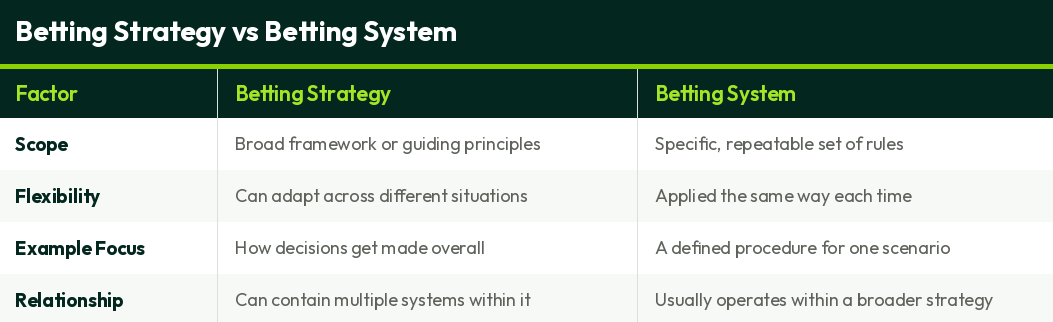
In practice, a betting system often operates as one specific application within a broader betting strategy. The strategy sets the overall principles; the system is one concrete procedure built to follow them consistently.
Final Thoughts
A sports betting strategy brings structure and consistency to decision-making, built around analytical concepts like odds, probability, and value, alongside risk-management principles like bankroll and stake control. None of it removes the underlying uncertainty of sports outcomes, what it changes is how decisions get made, not what actually happens once a wager is placed.
Related Terms
- What Is a Sports Bet Calculator: a tool often used alongside a strategy to check potential returns
- What Is a Straight Bet: the basic wager structure most strategies are applied to
Supporting Content
- Case study: SEO for a global B2B iGaming provider: a real example of SEO applied in the iGaming space
- iGaming SEO Services: for operators building educational content around betting terminology