



The CPC meaning is straightforward: Cost Per Click is the amount an advertiser pays each time someone clicks their ad. It’s one of the core pricing metrics in digital advertising, used across Google Ads, Microsoft Ads, social media platforms, and affiliate marketing.
It’s worth being clear about what CPC actually measures. It reflects advertising cost, not campaign performance or marketing strategy on its own. A low CPC doesn’t automatically mean a campaign is working, and a high one doesn’t automatically mean it’s failing, that depends on what those clicks turn into.
How CPC Works
Under a cost per click advertising model, advertisers pay only when someone actually clicks the ad, not when it’s simply displayed. That’s the defining feature of pay-per-click (PPC) advertising as a whole: exposure is free, action costs money.
What an advertiser actually pays per click is decided through an ad auction. Every time a relevant search happens, competing advertisers are evaluated based on their bid amount and other quality signals, and the auction outcome determines the final cost per click for that impression. CPC sits inside this broader PPC system as the specific price tag attached to each individual click.
How CPC Is Calculated
The standard CPC formula is simple:
CPC = Total Ad Spend ÷ Total Clicks
If a campaign spends $500 and generates 250 clicks, the average CPC works out to $2.00 per click.
It’s worth distinguishing between two versions of this number. Average CPC is the number most advertisers look at, the total spend divided by total clicks across a campaign or ad group. Actual CPC refers to what was paid for a single specific click, which can vary click to click depending on that moment’s auction. Reported CPC values shift over time as auction conditions, competition, and campaign performance change, so a CPC calculator pulling from live campaign data will rarely show a perfectly flat number.
What Factors Affect CPC
CPC isn’t fixed, and there’s no single answer to what is a good CPC across all industries. What counts as reasonable in one market can look expensive or cheap in another, since click costs depend on several factors working together:
- Keyword competition: how many advertisers are bidding on the same terms
- Quality Score: how relevant and effective an ad and its landing page are
- Bidding strategy: manual versus automated bidding approaches
- Industry: some sectors have inherently pricier keywords than others
- Audience targeting: broader versus narrower targeting settings
- Device: mobile and desktop clicks are often priced differently
- Location: geographic targeting affects competition levels
- Seasonality: demand spikes around certain times of year push costs up
- Ad relevance: how well an ad matches the search query it’s shown for
The Role of Keyword Competition
Highly competitive, high-commercial-intent keywords tend to carry a much higher CPC than niche or low-demand terms. A keyword like “buy car insurance online” attracts far more advertiser demand, and therefore a higher cost per click, than a specific, less-searched long-tail phrase in the same industry.
How Quality Score Influences CPC
Google’s Quality Score factors in expected click-through rate, ad relevance, and landing page experience to judge how useful an ad actually is to the person seeing it. Within the ad auction, a higher Quality Score can lower the CPC needed to achieve the same ad position, since Google rewards ads it expects will perform well with a lower effective cost.
CPC vs. Other Digital Marketing Metrics
CPC is just one metric in a wider set of numbers advertisers track, and it’s easy to confuse it with related ones.
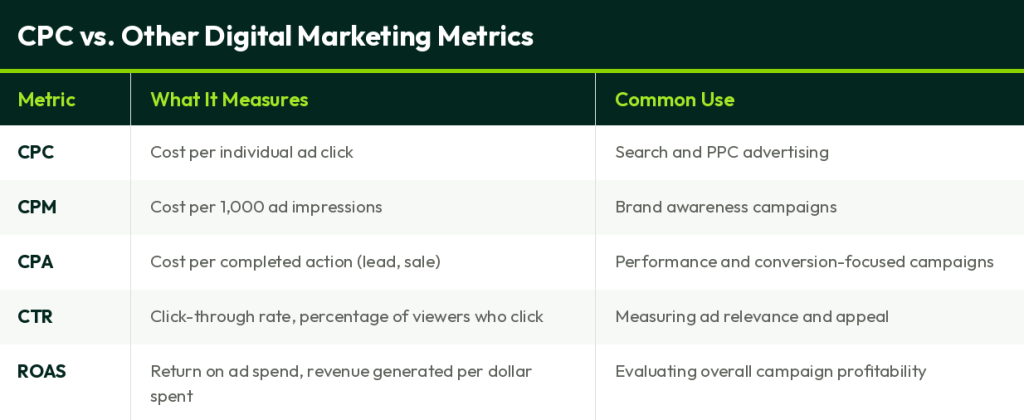
CPC and CPM sit at opposite ends of a similar idea, paying per click versus paying per exposure. CTR feeds directly into CPC through Quality Score, while CPA and ROAS shift the focus from cost of traffic to what that traffic actually delivers. None of these metrics tells the full story alone, which is why most PPC reporting tracks several of them together.
Final Thoughts
CPC measures exactly one thing: what a click costs. Understanding the formula behind it, and the factors that push it up or down, makes it much easier to read a PPC report accurately instead of judging a campaign on cost alone. For businesses weighing paid traffic against long-term organic growth, it’s also worth comparing CPC costs against the compounding value of a solid full-cycle SEO strategy, since organic clicks don’t carry a per-click price tag once a page is ranking well.
Related Terms
- What Is a Headline: a factor in ad relevance and click-through rate, both tied to CPC
- What Does SEO Stand For: the organic counterpart to paid, per-click traffic
Supporting Content
- Google Ads Help: About CPC Bidding: Google’s own documentation on how CPC bidding works
- Full-Cycle SEO Services: for building organic traffic alongside or instead of paid campaigns