



A blockchain casino is an online gambling platform built on blockchain technology, using cryptocurrency for payments and decentralized systems to record and verify transactions. Instead of relying solely on a traditional payment processor and a private internal ledger, these platforms settle transactions on a public or permissioned blockchain.
The core idea is straightforward: keep the games familiar, slots, poker, blackjack, roulette, while changing how money moves and how fairness gets verified underneath. The sections below break down exactly how that works in practice.
How Blockchain Technology Is Used in Online Gambling
At the infrastructure level, a blockchain casino relies on a decentralized network rather than a single centralized server controlling every transaction. Records get distributed across that network instead of sitting in one private database.
This matters for two main reasons. First, transactions become transparent and traceable, since blockchain records are typically viewable and verifiable independently of the casino itself. Second, cryptocurrency payments, Bitcoin, Ethereum, and various tokens, settle without relying on traditional banking rails, which changes both the speed and structure of deposits and withdrawals.
How Does a Blockchain Casino Work?
The player journey looks similar to a standard online casino at first glance, with a few key differences underneath.
A player creates an account, then connects a cryptocurrency wallet instead of entering traditional payment details. Funds get deposited by sending crypto from that wallet to an address provided by the platform. From there, players place bets as usual, but each transaction, deposits, bets, and withdrawals, gets recorded and confirmed on the blockchain rather than only in the casino’s internal system.
Withdrawals follow the same logic in reverse: winnings get sent back to the player’s wallet as a blockchain transaction, verified through the same network used for the deposit.
Cryptocurrency Wallets and Transactions
A crypto wallet is what holds a player’s funds and generates the wallet address used to send and receive cryptocurrency. Every deposit or withdrawal is a transaction tied to that address, recorded permanently on the blockchain.
Blockchain confirmations are what make a transaction final. Rather than an instant, invisible database update, a transaction needs to be verified by the network, a process that can take anywhere from seconds to several minutes depending on the specific blockchain being used. Once confirmed, that transaction record is effectively permanent and independently verifiable.
Core Features of Blockchain Casinos
A few characteristics define blockchain casinos beyond the payment method alone.
- Provably fair gaming: a system that lets players independently verify a game’s outcome was generated fairly, rather than simply trusting the operator’s word.
- Smart contracts: self-executing code that can automate payouts or enforce game rules without manual intervention from the casino.
- Decentralized verification: transaction and, in some cases, game outcome data that can be checked against the blockchain rather than relying solely on the platform’s internal records.
- Transparent transactions: a public or semi-public record of deposits, bets, and withdrawals that exists independently of the casino’s own reporting.
Together, these features shift some of the trust in a traditional casino toward technology that players can verify themselves.
Blockchain Casino Games
Game selection at most blockchain casinos closely resembles what’s available anywhere else: slots, poker, blackjack, and roulette are all common. Blockchain technology mainly changes payments, security, and outcome verification, not the underlying gameplay mechanics themselves.
A slot machine on a blockchain casino still spins the same way a traditional online slot does. The difference lies in how the bet gets placed, how the outcome can be verified, and how winnings ultimately get paid out.
Advantages and Limitations
Like any technology-driven shift, blockchain casinos come with real trade-offs rather than a one-sided upgrade.
Advantages:
- Transparency, since transactions and often game fairness can be independently verified
- Payment speed, particularly for withdrawals, which can settle faster than traditional banking methods in many cases
- Accessibility, since crypto wallets can offer an alternative for players in regions with limited traditional banking access
Limitations:
- Regulatory uncertainty, since blockchain and crypto gambling regulations vary widely and continue to evolve across jurisdictions
- Cryptocurrency volatility, meaning the value of deposited or won funds can shift significantly based on crypto market movement
- Technical barriers, since managing a crypto wallet and understanding blockchain transactions adds a learning curve that traditional payment methods don’t require
Neither side of this list should be treated as universal. The right fit depends heavily on a player’s comfort with crypto and the specific platform’s regulatory standing.
Blockchain Casinos vs Traditional Online Casinos
The two models share the same core gaming experience but differ meaningfully underneath:
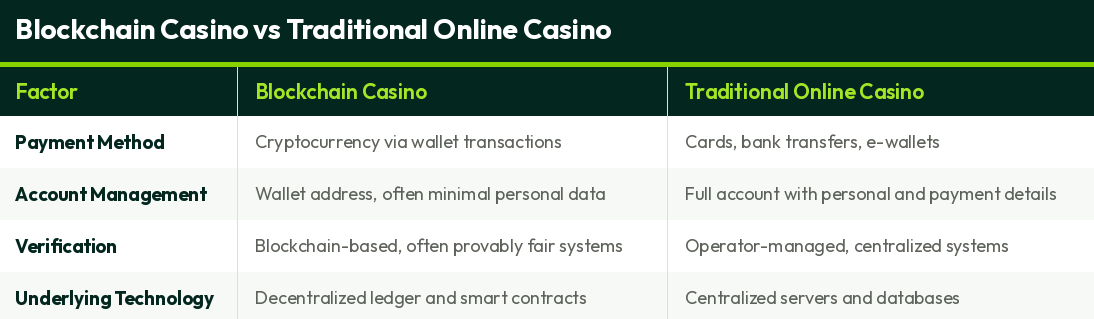
Neither model is inherently better across the board. A blockchain casino suits players comfortable with crypto and interested in independently verifiable fairness, while a traditional online casino offers a more familiar payment experience without the added complexity of wallet management.
Related Terms
- What Is a Social Casino: a different alternative wagering model built around virtual currency rather than crypto
- What Is Casino House Edge: a mathematical concept that applies to blockchain casino games just as it does elsewhere
Supporting Content
- Case study: SEO for a global B2B iGaming provider: a real example of SEO applied in the iGaming space
- iGaming SEO Services: for operators building visibility across crypto and traditional gaming platforms